
how to use ai for your business
Learn how to leverage AI for your business to save time, enhance customer support, develop superior marketing strategies, automate everyday tasks, and expand your business more effectively.
Artificial intelligence (AI) has transitioned from being a futuristic concept exclusive to large corporations. Nowadays, enterprises of all sizes—from small local establishments to international brands—are leveraging AI to enhance customer service, boost sales, automate processes, and conserve time. Regardless of whether you operate a restaurant, a shoe store, an online business, an agency, or a service-oriented company, AI can assist you in accelerating growth and optimizing efficiency.
In straightforward terms, AI denotes computer systems capable of executing tasks that typically necessitate human intelligence. These tasks encompass content creation, responding to customer inquiries, data analysis, image generation, video production, trend forecasting, and much more.
Numerous business proprietors perceive AI as costly or challenging to implement. Nevertheless, contemporary AI tools are tailored for novices. There is no requirement for coding skills or technical knowledge to commence utilizing AI in your business.
In this comprehensive guide, you will discover how to implement AI in your business, the advantages of AI, the top AI tools currently available, and practical methods to integrate AI into real-world business operations.
What Does AI Mean in Business
AI in the business context refers to the application of intelligent software and automation technologies to enhance everyday operations. These technologies assist organizations in executing tasks more swiftly, minimizing human labor, and refining decision-making processes.
For instance:
The AI chatbots have the ability to deliver prompt replies to customer questions.
Artificial Entaligance writing software is capable of generating blog posts and marketing materials.
AI analytical tools are designed to assess consumer behavior.
AI automation systems can effectively manage repetitive tasks.
Organizations primarily implement AI to:
Conserve time
Lower expenses
Boost productivity
Enhance customer satisfaction
Increase sales
Reasons Businesses Are Embracing AI
AI has gained traction due to its tangible benefits. Rather than employing extensive teams for every task, companies can leverage AI tools to enhance efficiency in their operations.
AI is capable of automating mundane tasks such as:
Responding to emails
Arranging meetings
Crafting product descriptions
Overseeing inventory
Generating reports
This enables business leaders to concentrate on growth and strategic planning.
Recruiting staff for every minor task can incur significant expenses. AI tools help lower labor costs by automating various functions.
For instance:
A single AI chatbot can manage thousands of customer inquiries.
AI writing applications can produce content rapidly.
Customers anticipate prompt replies. AI facilitates businesses in offering round-the-clock support via chatbots and automated systems.
AI tools can:
Suggest products
Tailor offers
Examine purchasing patterns
Enhance marketing strategies
This assists businesses in drawing in more customers and boosting conversion rates.
AI can process vast quantities of data and deliver insights regarding:
Market dynamics
Customer inclinations
Sales metrics
Inventory requirements
Optimal Methods for Implementing AI in Your Business
Numerous practical applications exist for businesses to leverage AI. Let us examine the most beneficial uses.
1. AI for Customer Support
Customer support ranks among the most prevalent applications of AI.
AI chatbots are capable of:
Responding to frequently asked questions
Monitoring order statuses
Assisting customers in product selection
Resolving simple issues instantly
These bots operate around the clock without interruption.
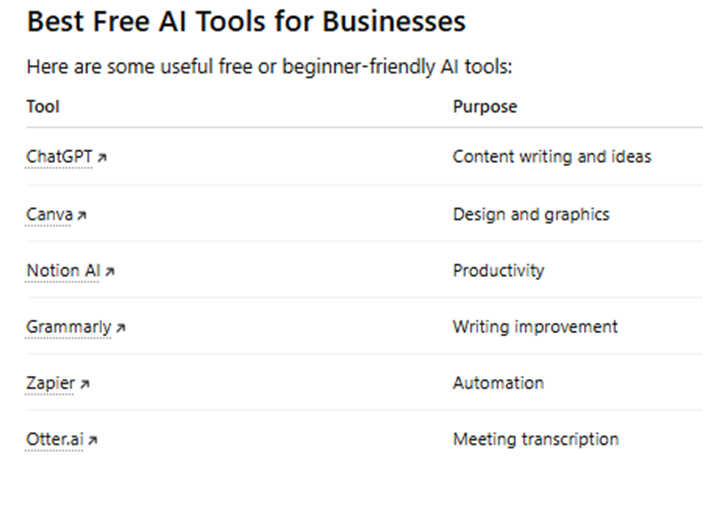
Notable AI chatbot solutions include:
ChatGPT
Intercom
Zendesk
Example
Consider a scenario where you own a shoe store. Customers might inquire:
“Do you have size 9?”
“What is your return policy?”
“When will my order arrive?”
An AI chatbot can automatically respond to these queries.
2. AI for Content Creation
Content marketing holds significant importance for all businesses. AI tools can assist in generating:
Blog posts
Social media captions
Advertising copy
Email marketing campaigns
Product descriptions
Video scripts
Popular AI content generation tools include:
Jasper AI
Copy.ai
Canva AI
Example
A restaurant owner might utilize AI to produce:
Daily posts for Instagram
Promotions for festivals
Descriptions of food items
Emails for customers
3. AI for Social Media Marketing
Overseeing social media can pose challenges for small enterprises. AI tools can:
Generate posts
Recommend hashtags
Schedule content
Analyze engagement metrics
Create images and videos
AI enables businesses to maintain an active online presence without dedicating excessive hours each day.
Top AI Social Media Tools
Buffer
Hootsuite
Canva
4. Uses AI for Sales and Lead Generation
AI can assist businesses in identifying potential customers and enhancing sales.
AI sales tools can:
Monitor customer behavior
Anticipate purchasing intent
Dispatch personalized emails
Suggest products
Automatically score leads
Example
If an individual visits your website multiple times, AI can recognize that person as a high-potential customer and automatically send a discount email.
Popular tools include:
HubSpot
Salesforce Einstein
5. AI for E-Commerce Businesses
AI is revolutionizing the online shopping experience.
E-commerce companies utilize AI for:
– Product suggestions
– Customized shopping experiences
– Customer service
– Inventory oversight
– Adaptive pricing
Example
When you browse online and encounter “Recommended for You,” that is AI functioning behind the scenes.
Notable e-commerce AI platforms include:
– Shopify Magic
– Klaviyo
6. AI for Data Analysis
Companies gather vast amounts of data daily. AI can swiftly analyze this information and deliver valuable insights.
AI analytics assists businesses in comprehending:
– Which products are the top sellers
– Which marketing strategies are effective
– Customer purchasing behaviors
– Upcoming trends
Example
A clothing retailer can leverage AI to determine:
-The footwear is the most sought after
– Which season yields the highest sales
– Which items need to be replenished
7. AI for Automation
The automation process is among the most substantial advantages offered by artificial intelligence.
AI automation tools can handle:
– Email responses
– Scheduling appointments
– Generating invoices
– Data entry tasks
– Managing workflows
Popular automation solutions include:
– Zapier
– Make
Example
A business owner can integrate:
– Website forms
– Email marketing platforms
– CRM systems
– Google Sheets
Everything updates seamlessly without the need for manual intervention.
8. AI for Graphic Design and Videos
AI design tools assist businesses in producing professional visuals without the need to hire designers.
Businesses can create:
Logos
Posters
Advertisements
Product photos
Videos
Thumbnails
Popular tools include:
Canva
Adobe Firefly
How Small Businesses Can Begin Utilizing AI
Small businesses should initiate their journey with straightforward AI tools rather than attempting to use everything simultaneously.
Step 1: Identify Repetitive Tasks
Consider the following questions:
Which tasks consume excessive time?
The tasks are performed on a daily basis?
Which tasks are suitable for automation?
Step 2: Select One AI Tool
Focus on one specific area:
Customer support
Marketing
Content writing
Automation
Step 3: Evaluate and Measure Outcomes
Monitor the following:
Time saved
Increased sales
Decreased costs
Enhanced customer satisfaction
Step 4: Gradually Expand
Once you feel at ease, incorporate additional AI tools.
Common Errors Companies Encounter with AI
Numerous companies struggle due to improper utilization of AI.
1. Overusing Various Tools
Begin with a small scope. Concentrate on addressing one issue initially.
2. Overlooking Human Creativity
AI is meant to assist humans, not to entirely supplant them.
3. Implementing AI Without a Clear Strategy
Consistently inquire:
What issue am I addressing?
In what ways will AI enhance this procedure?
4. Failing to Verify AI Content
Content generated by AI must always be assessed for precision and quality.
The Future of AI in Business
The technology of artificial intelligence is advancing swiftly. In the coming years, businesses are expected to utilize AI for:
Enhanced automation
Tailored customer experiences
Intelligent virtual assistants
AI-driven advertising
Forecasting business strategies
Organizations that embrace AI at an early stage may secure a significant competitive edge.
FAQs
1. What does AI mean in the context of business?
AI in business refers to the application of intelligent software and automation technologies to enhance business processes, customer service, marketing efforts, and decision-making capabilities.
2. Are small businesses able to utilize AI?
Indeed, small businesses can readily adopt AI tools for purposes such as content generation, automation, customer assistance, and marketing strategies.
3. Is coding knowledge necessary to utilize AI?
No, the majority of contemporary AI tools are designed to be user-friendly and do not necessitate any coding expertise.
4. Is the implementation of AI costly for businesses?
Numerous AI tools provide free tiers or reasonably priced subscription options suitable for small enterprises.
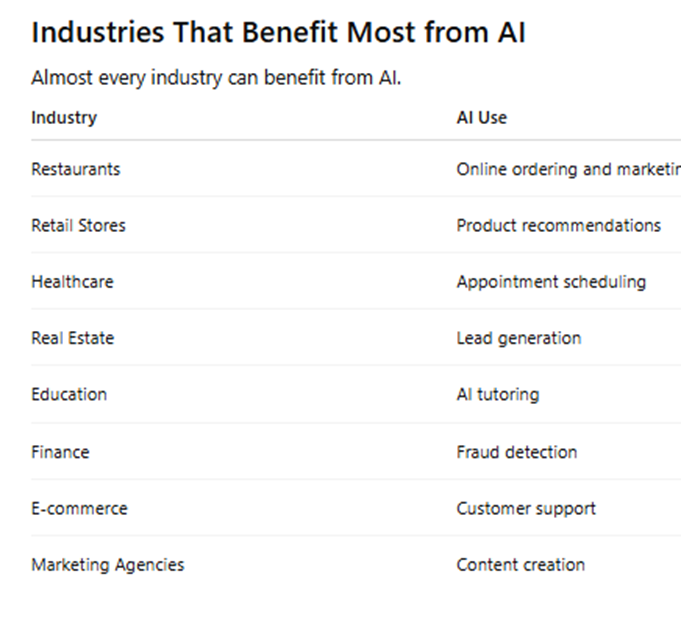
5. Which sectors of business gain the most advantages from AI?
The areas of customer support, marketing, sales, automation, and data analysis derive the greatest benefits from AI technologies.